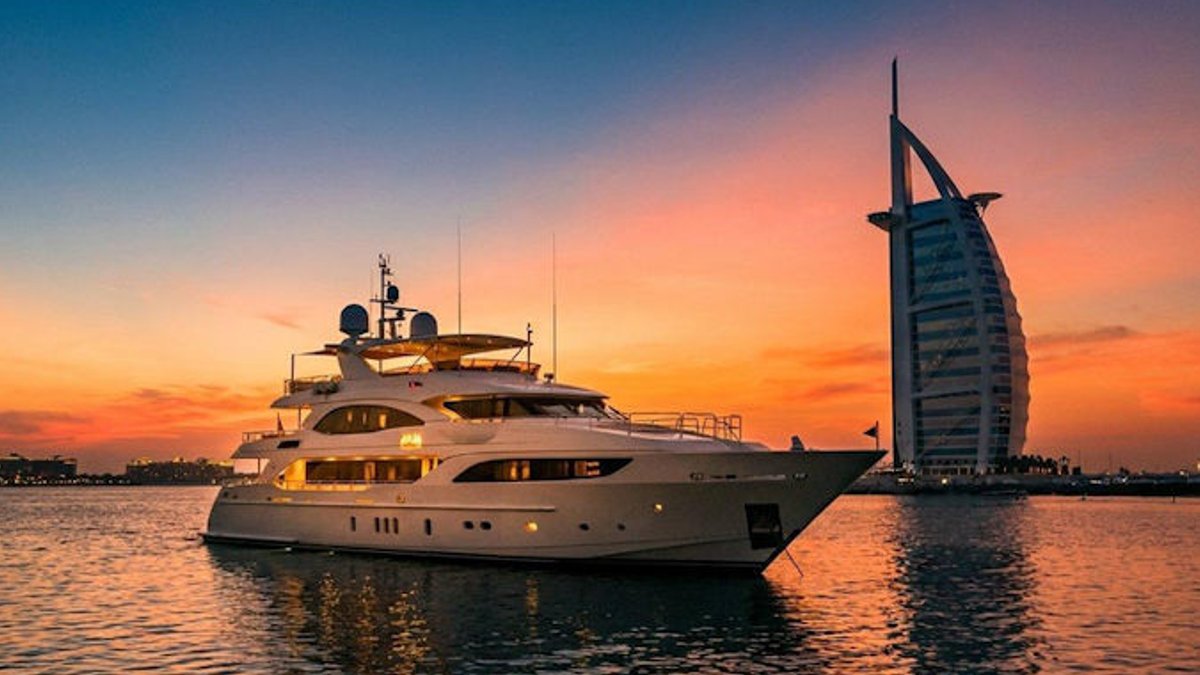
A well-designed Dubai yacht evening functions less like a booked charter and more like a composed experience. The most successful events rely on three specific elements: the Marina and Palm Jumeirah skyline as a photographic backdrop, the specific quality of Dubai golden-hour light between October and April, and the curated onboard detail (florals, tableware, playlist, lighting) that a professional team stages before guests ever board. The evenings that read as designed rather than delivered are the ones where a professional crew, not a checklist, produces them.
Visuals differ from Mediterranean or Caribbean equivalents because Dubai’s skyline offers a modern architectural backdrop that coastal coastlines and beaches cannot provide. The setting is architectural, not natural. Mediterranean yacht escapes rely on Adriatic cliffs, whitewashed villages, and pine-scented coastlines. Dubai relies on the Marina tower canyon, the Palm Jumeirah geometry, and the Burj Al Arab silhouette. The city is the setting, not a backdrop for a coastal setting.
The light is stronger and more predictable. Dubai’s golden hour is more consistent day to day than the Mediterranean’s, which shifts significantly with weather systems. October through April, a Dubai golden hour arrives on schedule and delivers the same photographic quality. That predictability lets a designed evening be planned around a specific 25 to 30 minute window with confidence.
The design vocabulary is contemporary. Dubai’s aesthetic references glass, steel, marina infrastructure, and modernist geometry. A yacht evening in Dubai that leans classical or traditional in its onboard styling reads mismatched to the setting. The evenings that work visually adopt a contemporary palette that echoes the city rather than importing a Mediterranean or Caribbean design template.
Related: Slow Luxury Travel Gains Ground Among Wealthy Travelers
A well-designed Dubai yacht evening uses one of three primary photographic axes. Sophisticated operators pick the axis based on the guest’s photographic preference, not the operator’s default route. The axis choice is a design decision, not a logistics decision.
Axis one: Marina tower canyon on return. The boat leaves Dubai Marina at 16:30 or 17:00, cruises out toward Palm Jumeirah, and returns under the tower canyon at dusk. The vertical geometry of the Marina towers on both sides of the boat produces the composition that most guests recognise as “the Dubai shot” from luxury travel imagery.
Axis two: Palm Jumeirah crescent from open water. The boat departs Dubai Harbour and heads out beyond the Palm; the anchor stop places the boat with the Palm’s crescent tip in the frame. The composition emphasises the man-made geometry of the Palm against the natural horizon of the Gulf.
Axis three: Burj Al Arab silhouette from Mina Rashid. The boat departs Mina Rashid and cruises along the Jumeirah coastline; the Burj Al Arab silhouette appears mid-cruise and becomes the anchor image for the evening. The composition is architecturally singular and difficult to duplicate anywhere else in the world.
The difference between a designed evening and a delivered one is what happens before guests board. The evenings that read as designed have all six of these ready before the first guest boards. The evenings that read as delivered have two or three of them, and the crew scrambles to add the rest during boarding.
Related: Luxury Pet-Friendly Wilderness Escapes in the US
Six elements should be complete before boarding. Florals matched to a colour brief: either a neutral seasonal palette or a specific colour the guest of honour or host has requested. Loose stems in low vessels beat tall centrepieces on a boat where wind is a factor.
Glassware and tableware appropriate to the meal: proper glassware for wine or champagne, not the operator’s default catering ware. This is a small detail with a disproportionate visual return. Table linen or runner in a considered material: natural linen, not polyester. The texture reads in photos.
Ambient lighting for after-sunset: warm, low-lumen lighting that comes on gradually rather than fluorescent overheads. Fairy lights or lantern arrangements work if used sparingly; harsh spotlights do not. Playlist coordinated to the evening arc: softer instrumental during boarding and cruising, warmer vocal during dinner, more energetic transition after the toast if the evening extends. A shared playlist link makes this trivial to prepare and personal to execute.
A menu physically presented: printed or handwritten menu cards on each place setting. The gesture is small; the effect on guest experience is disproportionate.
Related: Recovering in Style After Medical Procedures Abroad
The design is invisible if the team is invisible. Three specific roles matter behind the scenes. The pre-boarding crew. The florals, table setup, lighting, glassware, and playlist should all be staged before guests board. This requires a crew that arrives 90 minutes to two hours before the guest boarding time, not 15 minutes.
The evening coordinator. One named person from the operator team owns the run-of-show, times the anchor stop against sunset, cues the toast, coordinates the photographer, and manages any changes to the plan without visible friction to the guests. This is the person whose absence the guests do not notice and whose presence produces the smooth evening.
The chef and service team. The meal is plated to match the mood and the light, not on the operator’s kitchen schedule. Courses are timed against the golden-hour window rather than against the clock. Service is discreet, not performative.
Operators who invest in these three roles produce designed evenings. Operators who default to a booked crew with a generic checklist produce delivered evenings. The difference shows in the photos, in the guest recall weeks later, and in whether the evening ends up being one the guests want to repeat.


