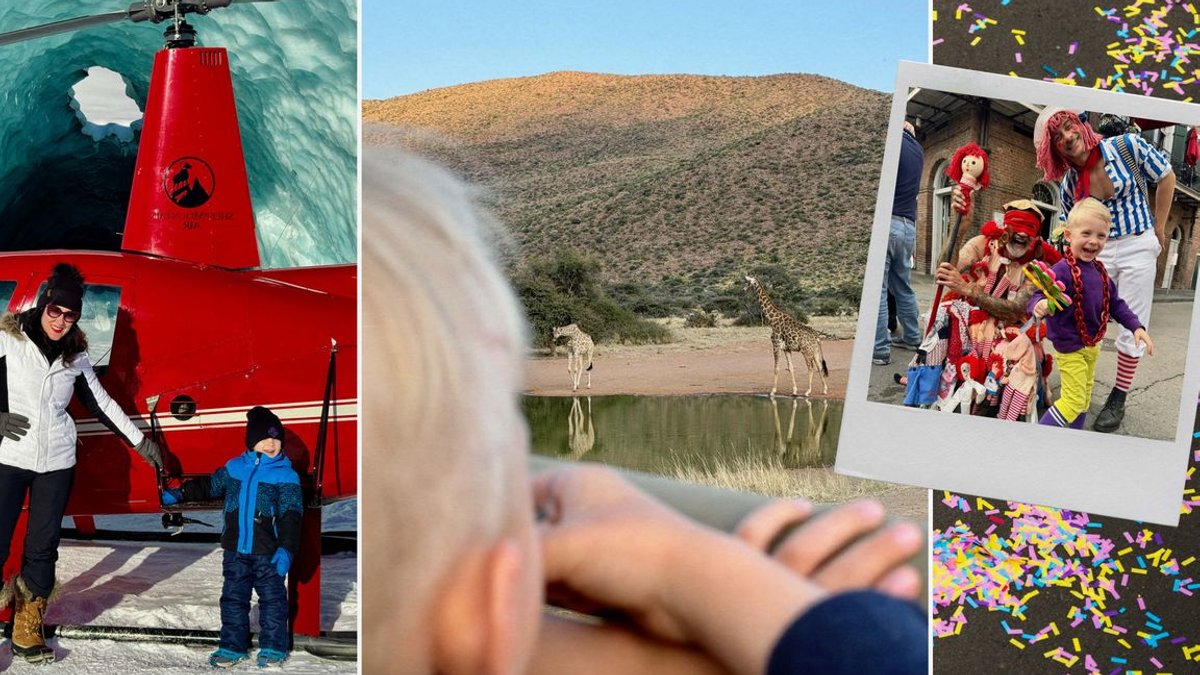
Parents frequently question whether exposing children to extreme travel is worthwhile, particularly when destinations seem impractical. One mother has settled this debate by repeatedly taking her son, Julian, on adventures that most families would dismiss as unsafe. Her approach challenges conventional parenting norms, proving that early exposure to diverse environments can shape a child’s perspective in lasting ways.
From Ice Fishing to the Indy 500
Julian’s first major trip began when he was five weeks old, as his mother booked a weekend ice-fishing excursion in Wisconsin. She framed the cold-water outing as his inaugural adventure. By 20 months, the pair had embarked on a 23-day journey spanning Oman, Tanzania, and the United Arab Emirates. Their route included desert traverses through the Wahiba Sands and mountain roads in the Hajar range before concluding with a safari in Tanzania.
A year later, the duo undertook an 88-day expedition across 14 countries and six continents. Their stop in India drew criticism from relatives, yet the crowded streets of Varanasi and Delhi left Julian unusually quiet, offering his mother an unexpected moment of calm. She has said parenthood has changed how she assesses risk, but fear has never gotten much of a vote in her life, and she doesn’t want it calling the shots in Julian’s either.
At three years old, Julian attended the Indianapolis 500 with police escort, VIP seating, and pit access—arrangements facilitated by his mother’s media connections. A sudden diaper failure mid-race led to an improvised solution: a size-XL Christmas sweater from the Speedway’s gift shop was repurposed into a makeshift dress, allowing them to remain in the grandstands as the race progressed.
Later that spring, the family attended Mardi Gras in New Orleans. Contrary to assumptions about rowdy festivities, they observed the parades from a high-floor Sheraton balcony equipped with lounge amenities. The main obstacle became a barrage of colorful beads, which Julian eagerly collected while dodging airborne trinkets.
Read Also: US Airlines Mishandled Over 1.1 Million Bags in 2026
This hands-on approach contrasts with earlier generations, which often kept young children indoors during major events. Today’s experiential parenting prioritizes cultural immersion over shielding kids from discomfort.
Alaska’s Frozen Adventures
For Julian’s first spring break, his mother selected Anchorage during the 54th annual Iditarod Trail Sled Dog Race. They stayed at The Wildbirch Hotel, securing front-row seats for the ceremonial start and easy access to the city’s winter festival, Fur Rondy.
The itinerary included snowmobile rides through midway courses and a playful “Running of the Reindeer” event, where participants in inflatable dinosaur costumes raced alongside real reindeer. The combination of whimsy and tradition left Julian enthralled.
After Anchorage, the family flew to Fairbanks, where temperatures dropped to -38°F. Julian developed a cough and spent a day indoors with an iPad before attending the World Ice Art Championships. There, they spent as much time in heated tents as they did sliding down ice tracks.
In the Mat-Su Valley, helicopter pilot Mark Fleenor transported the family over the Matanuska Glacier. Julian collected a fragment of blue ice, which Fleenor assisted in loading onto the aircraft. The boy carried this piece as a tangible keepsake from the frozen terrain.
Read Also: Whisky tour on Islay exceeds expectations
A sudden blizzard later extended their stay in Anchorage by 48 hours, but the mother viewed the delay as an unplanned addition to their Alaskan experience.
Safari Adventures in Africa
The next phase of their travels required a boutique operator specializing in unconventional routes. The agency organized a two-and-a-half-week circuit through South Africa and Madagascar, incorporating overnight stops in the Netherlands and a transcontinental trek across Ethiopia before reaching Africa.
In South Africa, they stayed at Tswalu Loapi in the Kalahari, where Julian joined game drives in search of cheetahs and rhinos. An unexpected highlight was a visit to the reserve’s staff-village school.
The Madagascar segment focused on the northwest coast, where a boutique lodge above the turquoise sea served as a base for exploring Lokobe National Park. Hikes through the dense forest revealed black lemurs leaping between vines and poison-dart frogs splashing color across the undergrowth. A large Malagasy boa coiled around a fallen log captivated Julian, who pointed it out with childlike excitement.


