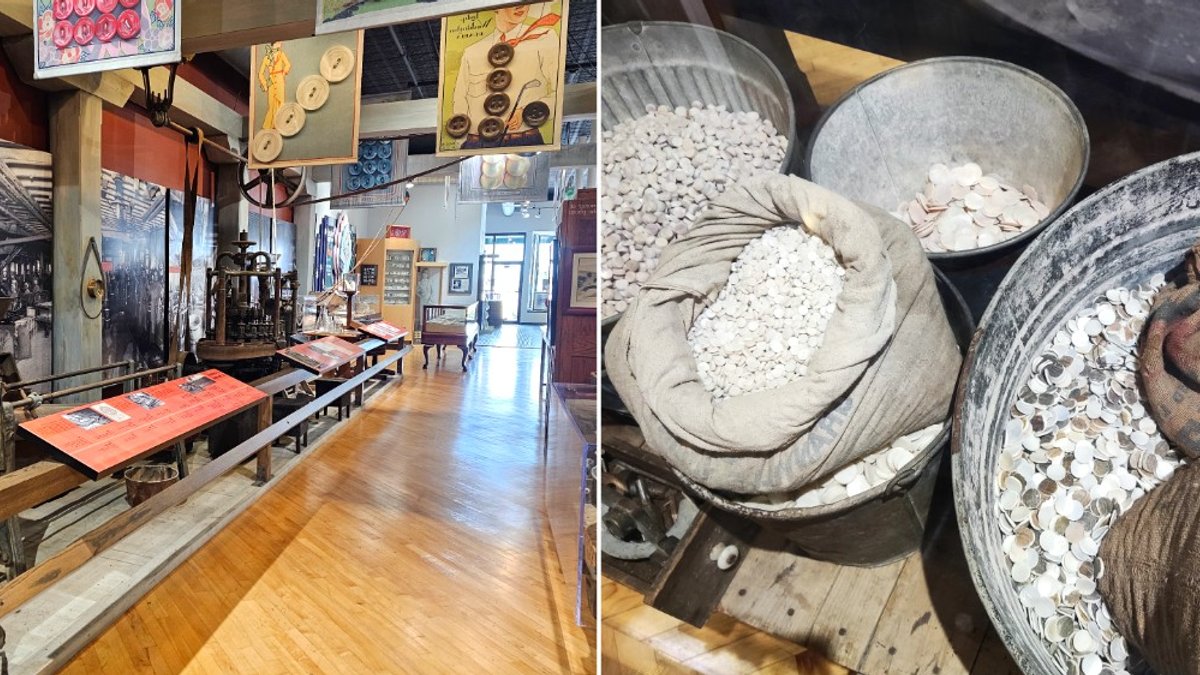
In a small Iowa town along the Mississippi River, a museum showcases the history of the button industry, which once thrived there. The story of this industry began with freshwater mussel shells pulled from the river, which were used to make pearl buttons. A German button maker, John F. Boepple, is credited with starting this industry in the late 19th century.
Boepple had previously made buttons from horn, bone, and seashells in Hamburg, but he found the freshwater mussel shells in the Mississippi River to be of high quality. He opened a small factory in Muscatine, Iowa, and began producing buttons using foot-powered machines. As the industry grew, other workshops and factories were established, and soon the town became a major center for button production.
At its peak, Muscatine produced over 1.5 billion buttons per year, which was roughly one-third of the world’s supply. The town’s output was so large that if the buttons were stacked side by side, they would reach a height of approximately 2,900 miles. The button industry employed over half of the town’s 3,500 wage earners, with many families having at least one member working in the industry.
Button Making Process
The museum’s first floor exhibits showcase the history of the button industry, with photos, product cards, and displays that highlight the significance of the industry to the town. Visitors can see examples of the shells used to make the buttons, as well as the machinery and equipment used in the manufacturing process. The museum also honors the workers who played a key role in the industry, including the clammers who harvested the mussel shells from the river.
The process of making a button involved several stages, including soaking the shells, cutting the blanks, smoothing and drilling the buttons, and sorting and packaging them for shipping. The museum’s exhibits provide a detailed look at each stage of the process, giving visitors a sense of the hard work and dedication that went into producing these small but essential items.
You can find it at The National Pearl Button Museum @ The History and Industry Center, 117 W 2nd St, Muscatine, IA 52761, in the state of Iowa.
Industry Challenges Arise
The button industry in Muscatine was not without its challenges, however. Workers faced long hours, low pay, and poor working conditions, leading to the formation of the Button Workers Protective Union and a major strike in 1911. The strike, which lasted for 15 months, drew national attention and highlighted the importance of the industry to the town’s livelihood.
A river town earned a nickname that stuck for decades. It is hard to imagine a bigger success for something so small. The industry’s success was due in part to the innovative machinery and equipment developed by local inventors. Machines made the real jump possible. Work that once took patient fingers now moved along a line of belts and blades. That meant more buttons per day and more jobs for the town. Efficiency helped Muscatine stay ahead of other places trying to copy the idea.
Despite the challenges, the button industry in Muscatine continued to thrive for many years. Mussels filter river water, so they are tiny cleaners hard at work. Sadly, button demand took a heavy toll on them. Within the first decade, beds near Muscatine ran low. Clammers had to search rivers across 19 states. North America is home to roughly 300 freshwater mussel species, but many have suffered serious population declines.
The Upper Mississippi River system historically supported dozens of species, and some have disappeared from its waters. Even Boepple eventually worked with the U.S. Bureau of Fisheries to protect them. The federal government set up the Fairport Biological Station near Muscatine to re-seed rivers with young mussels. Pollution and dams made that job harder.


